

Digital commerce has moved far beyond static catalogs and checkout pages. Buyers now expect answers in the moment, relevant guidance before they ask, and a connected experience across web, mobile, messaging, and support channels. For businesses running on HCL Commerce, that shift is especially important. Enterprise commerce environments often manage complex catalogs, multiple customer segments, contract pricing, regional experiences, and long consideration cycles. In that setting, delays, friction, or fragmented support can directly affect revenue. That pressure is rising fast.

The documented average cart abandonment rate remains about 70%, showing how often shoppers leave before converting.
Baymard85% of customers expect consistent interactions across departments, while 56% expect offers to be personalized.
Salesforce research
Well-executed AI-enabled customer service can improve engagement while also opening cross-sell and upsell opportunities.
McKinsey
These expectations are reshaping how commerce teams think about engagement. It is no longer enough to publish product information and wait for the customer to figure things out. Modern buyers want real-time support during discovery, evaluation, purchase, and post-purchase stages. They want to ask whether a product is in stock, whether a contract price applies, whether delivery dates are realistic, whether a replacement part is compatible, or whether an order can be changed after submission. When those answers are slow or unclear, hesitation grows.
This is where an HCL Commerce integrated AI agent becomes strategically valuable. Rather than functioning as a simple pop-up widget, an intelligent agent can connect with relevant commerce systems, understand context, and guide users toward the next best action. For businesses evaluating conversational commerce, this makes the difference between passive digital storefronts and responsive buying experiences.
Why conversational commerce matters in HCL Commerce environments
Traditional eCommerce was built around menus, filters, forms, and self-navigation. That model still matters, but customer behavior has changed. Shoppers increasingly prefer conversational interactions that reduce effort. Instead of searching across multiple product pages, they want to ask direct questions and receive direct answers.
In HCL Commerce environments, that shift is particularly relevant because many product and buying journeys are not simple. A buyer may need help with product compatibility, entitlement-based pricing, order status, location-specific delivery, account-specific recommendations, or return workflows tied to enterprise policies. Static interfaces often struggle to support those moments efficiently.
A chatbot for HCL Commerce help with basic FAQs, but a more advanced HCL Commerce integrated chatbot or AI agent typically goes further. The difference is not just language fluency. It is operational intelligence.

A basic chatbot often relies on prewritten flows and limited intent matching. An AI agent, by contrast, is designed to interpret intent, maintain context, pull live data, personalize responses, and support customers through decision-stage interactions. It can help a customer discover products, compare options, clarify uncertainty, and continue the journey without forcing them to switch channels or wait for a human response.
Generative AI-powered commerce agents for HCL Commerce environments
Rybo.ai, the AI business unit of Streebo, a global leader in AI and digital transformation, brings to the commerce sector a suite of cutting-edge, Generative AI-powered agents tailored for fast-moving businesses.
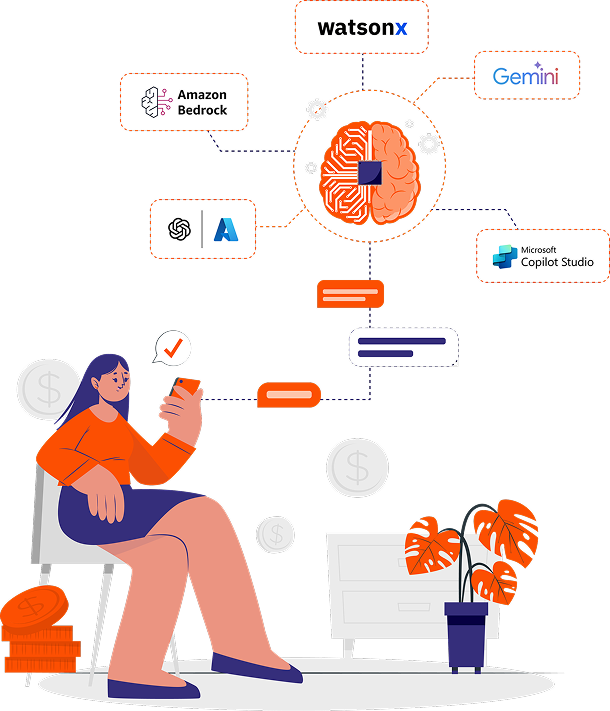
For HCL Commerce environments, these AI agents are built to support everything from product discovery, order management, inventory updates, entitlement-based pricing, customer interaction, and return workflows to backend commerce automation with 99%+ accuracy.
Powered by leading NLP and LLM platforms such as IBM watsonx, Microsoft Copilot Studio, Enterprise GPT on Azure, Google Gemini, Amazon Bedrock, and open-source stacks, these AI agents deliver context-aware, multichannel support across WhatsApp, Instagram, Facebook Messenger, Microsoft Teams, web portals, mobile apps, email, SMS, and voice assistants.
Their modular architecture allows seamless integration with ERP, CRM, customer support platforms, and eCommerce engines, including HCL Commerce, to automate operations and enable real-time business transactions at scale.
By combining conversational AI, enterprise system integration, and workflow automation, it helps HCL Commerce businesses modernize customer engagement, reduce support dependency, improve buying journeys, and deliver more intelligent commerce experiences across channels.
In an ideal implementation, the agent can access data points such as:
- product catalogs and attributes
- variants, bundles, and compatibility details
- inventory and availability
- pricing, promotions, and customer-specific terms
- order history and shipment status
- customer account context
- FAQs, policy content, and support workflows
- browsing patterns and shopping signals
This allows the agent to do more than answer surface-level questions. It can participate in commerce interactions in a way that supports actual business outcomes.
For example,
instead of saying,
- “Please contact support for availability,”
an effective AI agent can say,
- “This item is available in your region, the larger size is low in stock, and the estimated delivery window is three business days.”

Instead of replying with a generic policy link, it can explain whether a specific order is still eligible for modification. Instead of showing broad product categories, it can narrow recommendations based on user intent and account history. That is the practical value of AI agent integration with HCL Commerce: better timing, better relevance, and less friction.
How AI agent integration with HCL Commerce works
A strong implementation connects conversational AI to the systems that shape the buying journey. In many enterprise scenarios, that means the AI layer interacts with HCL Commerce APIs and adjacent business services rather than operating in isolation.
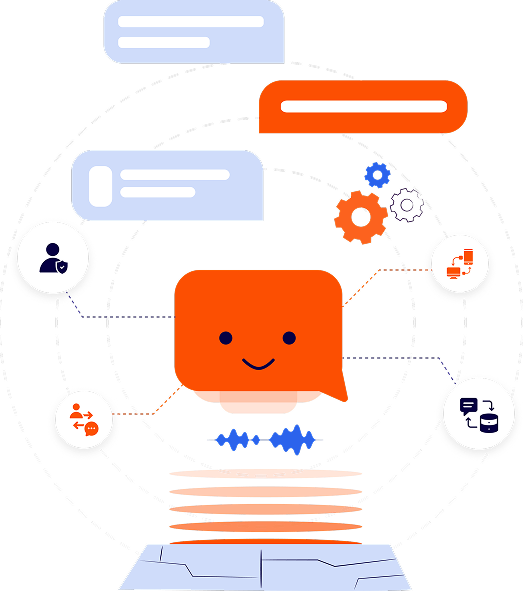
Core components of an ideal deployment include:
Old World vs New World
Scenario 1
Product Compatibility & Purchase Decision
Old World (Without AI Agent)

Result
Customer delays decision → leaves site → purchase lost or postponed.
New World (With HCL Commerce Integrated AI Agent)
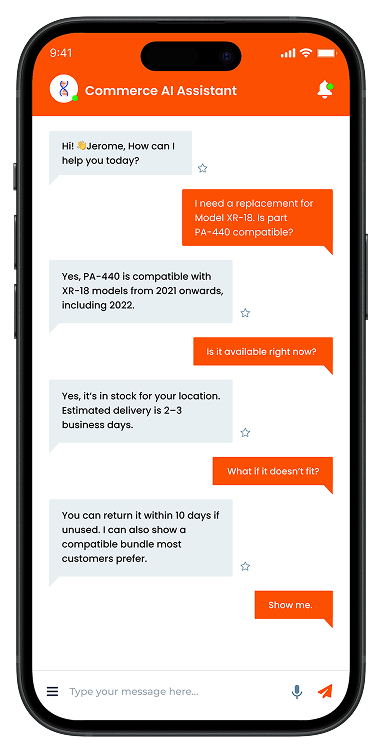
Outcome
Customer gets clarity → builds confidence → moves toward purchase.
Scenario 2
Cart Abandonment at Checkout
Old World (Without AI Agent)

Result
Cart abandoned.
New World (With HCL Commerce Integrated AI Agent)
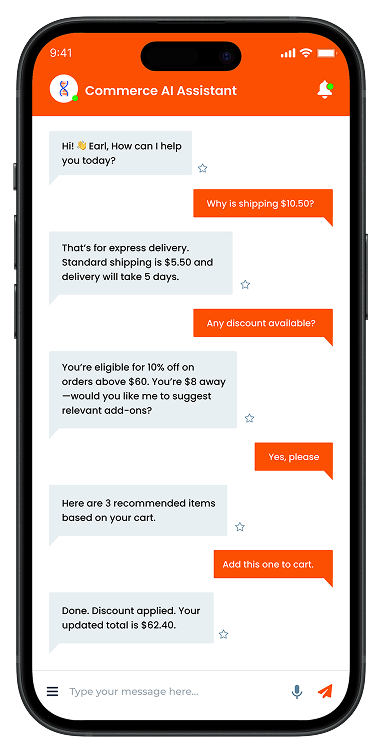
Outcome
Cart saved → upsell → purchase completed.
Scenario 3
Order Tracking & Post-Purchase Support
Old World (Without AI Agent)

Result
Uncertainty + poor experience.
New World (With HCL Commerce Integrated AI Agent)
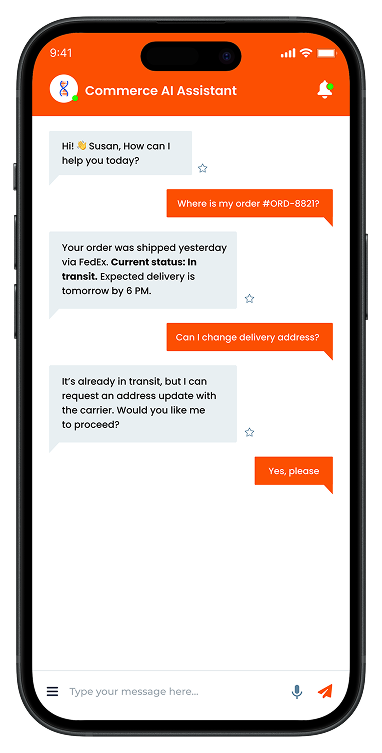
Outcome
Clear answers + faster resolution + better experience.
How an HCL Commerce integrated AI agent improves the customer journey


Real business use cases for HCL Commerce stores
 Customer support automation
  Cart abandonment reduction
  Product recommendation assistance
  Checkout-stage intervention
  Order tracking support
  Returns and replacements
  FAQ automation
  Cross-sell and upsell
  After-sales engagement

Business impact and adoption


Key differentiators of this HCL Commerce integrated AI agent solution
This HCL Commerce integrated AI agent solution is designed to help commerce businesses move beyond basic chatbot responses and deliver intelligent, real-time, and action-oriented customer experiences.


The AI agent can access both structured commerce data and unstructured content such as FAQs, policy documents, product manuals, knowledge bases, support articles, and internal documentation to provide more complete and relevant answers.


Conclusion
HCL Commerce environments often involve complex customer journeys, product structures, pricing rules, inventory conditions, and support workflows. A basic chatbot may help with simple FAQs, but an integrated AI agent can deliver far more value by connecting conversations with live commerce data and enterprise systems.With Generative AI-powered agents, businesses can provide faster answers, more personalized recommendations, automated support, and real-time transaction assistance across multiple channels. For enterprises using HCL Commerce, adopting an integrated AI agent is a practical step toward improving customer engagement, reducing operational friction, and building a smarter, more responsive digital commerce experience.
Start small. Scale as you prove ROI.
No setup fees. A 30-day trial is available so you can see it working on your own catalog first.
- Functionality: FAQs
- Source System: Website + Brochures + Docs (upto 10K Pages)
- Channels: ChatGPT + Web
- Functionality: FAQs + 3 Business Function
- Source System: Upto 3 Backend Systems
- Channels: ChatGPT + Web + Voice
- Functionality: FAQs + 5 Business Functions
- Source System: Upto 5 Backend Systems
- Channels: ChatGPT + Web + Voice + Email
All prices in USD. $/Hour reflects effective hourly cost based on estimated monthly usage.
Frequently Asked Questions (FAQs)

Ready to bring AI agents into your HCL Commerce environment?
Start modernizing your HCL Commerce experience with AI agents that make every customer interaction smarter, faster, and more personalized.
Get in touch now!