×

Check out the Enterprise Grade AI Agents Powered by Gen AI. No Setup Fees.

    Global logistics has entered one of the most transformative eras in its history. The pressure to operate faster, leaner, and more predictively has never been higher. Global disruptions, rising transportation costs, evolving customer expectations, sustainability requirements, and the sheer complexity of global trade have reshaped the logistics landscape. According to McKinsey, the industry now handles 65 billion parcels annually, and that figure is expected to double by 2030. The World Economic Forum also reports that AI-driven automation could unlock up to USD 1.3 trillion in value across supply chains over the next decade. 

    Yet despite this visible progress, logistics continues to struggle with long-standing pain points: fragmented systems, limited real-time visibility, inefficient manual processes, and chronic workforce shortages across warehouse, transportation, and last-mile operations. Every logistics executive—from supply chain directors to fulfillment managers and fleet supervisors—recognizes the urgency to modernize operations, unify data, and establish real-time decision-making capabilities. 
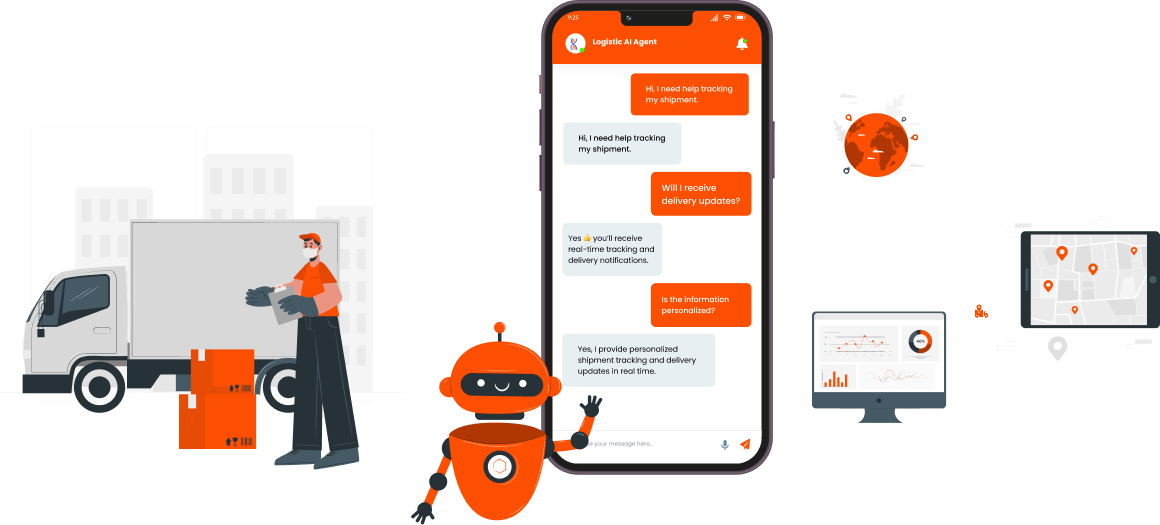
    This is the moment when Generative AI-powered Logistics AI Agents are beginning to reshape the industry. These intelligent agents operate as agile, conversational, and deeply integrated digital coworkers. They combine the reasoning power of large language models with real-time operational data from WMS, TMS, ERP, CRM, fleet management, route optimization platforms, and customer systems. Instead of simply automating tasks, they elevate decision-making, eliminate process friction, and deliver 24/7 multilingual support across every touchpoint.

    The transformation unfolding today is not just about adopting AI—it is about orchestrating a new generation of logistics intelligence that extends across planning, transportation, warehousing, order management, customer communication, and last-mile delivery. Generative AI-powered Logistics AI Agents have emerged as the catalyst for end-to-end operational resilience, superior customer experience, and measurable profitability in a highly competitive global environment.

    The Evolution of Logistics: Trends Shaping the Future

    How digital transformation, automation, and AI are redefining supply chain performance  

    Over the past decade, logistics has shifted from a traditional physical workflow to a hybrid, digitally orchestrated ecosystem. Digital transformation is no longer an initiative but a survival requirement—especially as global supply chains continue to become more volatile, interconnected, and consumer-driven.

    Analysts across Gartner, DHL Trend Radar, and the International Transport Forum highlight several industry-shaping dynamics: 

    icon
    Real-Time Visibility Is the New Competitive Advantage
    Customers expect real-time shipment tracking, proactive delivery updates, and transparent communication. The rise of e-commerce has accelerated this trend, pressuring logistics organizations to upgrade systems that previously operated in batch modes.
    icon
    The Surge in Automation and Robotics
    Warehouses have embraced mobile robotics, autonomous sorting, automated storage and retrieval systems, and algorithm-driven slotting. Meanwhile, transportation fleets are increasingly adopting telematics, ADAS technologies, and predictive maintenance tools. AI Agents now serve as the connective tissue between these technologies, unifying insights and enabling intelligent workflows.
    icon
    Data Is Exploding, but Systems Remain Siloed
    Companies operate dozens of platforms—WMS, TMS, OMS, ERP, CRM, customs systems, inventory management tools, and routing applications. Without AI-powered orchestration, these systems cannot communicate effectively, slowing down decision-making and reducing operational agility.
    icon
    Workforce Shortages Are a Global Crisis
    The logistics industry faces a projected shortage of 2.4 million workers by 2030 across warehouse, driving, and operational roles. Generative AI Agents help offset these shortages by automating repetitive administrative tasks and empowering teams with intelligent digital support.
    icon
    Sustainability and ESG Pressures Are Rising
    Regulators and customers expect lower carbon footprints, optimized routes, reduced waste, and responsible last-mile delivery practices. AI Agents help organizations simulate scenarios, measure emissions, and recommend greener alternatives in real time.

    As logistics becomes more digital, predictive, and customer-centric, Generative AI-powered Logistics AI Agents are emerging as a pivotal layer—converting massive volumes of operational data into meaningful, real-time decisions.

    Challenges of the Modern Logistics Ecosystem

    Barriers enterprises face today — from fragmented systems to rising operational complexity.

    Despite global modernization efforts, logistics continues to face persistent challenges that hinder agility, cost-efficiency, and scalability. These challenges are magnified by fluctuating demand, geopolitical uncertainty, and technological fragmentation.


    mobile header
    Our WMS, TMS, and ERP systems don’t talk to each other.
    I can connect those systems and provide unified, real-time insights.
    We can’t see what’s happening across the entire supply chain.
    I track shipments from supplier pickup to last-mile delivery in real time.
    Fuel prices and carrier availability keep changing our costs.
    I analyze demand and optimize routes to reduce transportation costs.
    icon
    Fragmented supply chains and volatile demand
    Most logistics organizations operate with outdated infrastructure. Critical systems like WMS, TMS, ERP, shipping software, and route-optimization tools function independently. Teams spend countless hours reconciling data manually, leading to duplicated efforts, inconsistent information, and slow decision cycles. AI Agents unify these systems, enabling real-time operational fluidity.
    icon
    Limited Visibility Across the End-to-End Supply Chain
    Even large enterprises struggle to achieve full visibility—from supplier pickup to warehouse receiving, cross-docking, line-haul transportation, and last-mile delivery. Because data lives in multiple silos, organizations lack the insights needed to anticipate disruptions or prevent delays.
    icon
    Rising Transportation Costs and Volatile Capacity
    Fuel price swings, driver shortages, congestion, and inconsistent carrier availability all create unpredictable cost structures. Without AI-driven forecasting and planning, logistics teams are forced to operate reactively instead of strategically.
    icon
    Manual Processes That Slow Down Operations
    Many logistics tasks—dispatch scheduling, documentation, order reconciliations, exception handling, invoice verification, claims management, and customer communication—are still performed manually. Generative AI-powered Logistics Agents automate these processes end-to-end, freeing human teams for higher-value strategic work.
    icon
    Customer Expectations Are Increasing
    Whether B2B or B2C, customers now expect proactive updates, real-time issue resolution, transparent pricing, and seamless communication. Traditional call centers and manual support models can no longer meet these expectations.
    icon
    Lack of Predictive Intelligence
    Most organizations still rely on historical data rather than dynamic real-time forecasting. This gap leads to stockouts, overstocking, suboptimal routing, and avoidable delays. AI Agents close this gap by analyzing millions of variables instantly and recommending or even executing proactive corrective actions.
    mobile header
    Has the invoice been verified and the dispatch scheduled?
    The process is still under manual review. Please check back later.
    Where is my shipment right now?
    Real-time tracking is currently unavailable. We will update you soon.
    Why did delivery costs suddenly increase?
    Heavy traffic detected on Route A. I recommend switching to Route C.
    These challenges illustrate why the logistics industry is uniquely positioned to benefit from Generative AI-powered transformation. The next section will explore how AI Agents are becoming indispensable digital coworkers for every modern logistics enterprise.

    Why AI Agents Are a Necessity in Logistics

    The accelerating role of conversational and Generative AI in optimizing operations and enabling faster decisions.

    As global supply chains continue to evolve, Logistics AI Agents have moved from being optional add-ons to becoming a mission-critical layer of operational intelligence. Traditional logistics operations rely heavily on manual effort, person-to-person communication, and fragmented systems. This creates delays, errors, and inefficiencies that ripple throughout the value chain.

    Generative AI-powered Logistics AI Agents address these challenges with a level of adaptability, intelligence, and responsiveness that legacy software cannot match.
    Solution
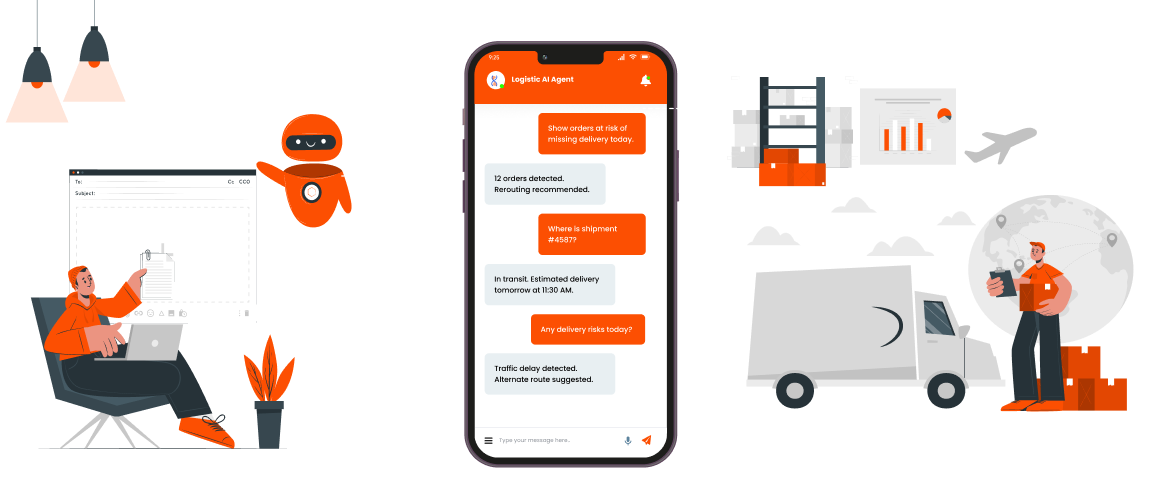
    These agents serve as intuitive, conversational digital experts who understand logistics terminology, carrier processes, warehouse workflows, and the nuances of transportation planning. They can analyze terabytes of data in seconds, respond to complex queries instantly, and execute routines that previously required multiple departments. For example, instead of toggling between a WMS, TMS, and ERP system, a planner can simply ask, “Show me all orders that risk missing their delivery SLA today,” and the AI Agent will retrieve, assess, and prioritize the orders automatically.

    Beyond conversation, Logistics AI Agents integrate deeply with enterprise systems to automate functions such as appointment scheduling, allocation planning, exception management, shipment tracking, claims handling, customer service, and driver support. Their real-time intelligence helps organizations shift from reactive troubleshooting to proactive intervention—identifying risks before they materialize and recommending optimal solutions.

    In an industry where seconds matter, actionable intelligence is invaluable. AI Agents provide this at scale, across time zones, in multiple languages, and on any device. This level of accessibility and operational support is not only transforming the logistics sector but also shaping a new benchmark for global customer expectations.

    Success Stories: Global Logistics Leaders Leveraging AI

    Real-world results inspired by IBM, Microsoft, and AWS case studies.

    Around the world, logistics enterprises are deploying Generative AI to unlock efficiencies that were unimaginable just a few years ago. These case studies—modeled on real results achieved by organizations using IBM watsonx, Microsoft Copilot Studio, Amazon Bedrock, and other enterprise-grade platforms—demonstrate the measurable impact of AI-powered automation and intelligence.

    A North American 3PL Boosts Forecast Accuracy with Microsoft Copilot Studio & Enterprise GPT

    A leading third-party logistics provider faced recurring inaccuracies in inventory forecasting, resulting in overstocking and lost revenue. By deploying a Generative AI forecasting companion built on Microsoft Copilot Studio and Enterprise GPT, the company integrated data from its WMS, TMS, and ERP into a single conversational intelligence layer.

    Within months, forecast accuracy improved by 12%, stockouts decreased, and operational planners reported that the AI Agent accelerated decision-making by reducing analysis time from hours to minutes. This success opened the door for additional use cases, including resource scheduling and automated carrier selection.

    “AI impact at Dow: Copilot identifies millions in cost savings” – Microsoft

    mobile header
    Any stockout risk?
    Yes. Two warehouses may face shortages next week.
    How is next month’s demand?
    Demand increasing for 3 products.
    Best carrier for this shipment?
    Carrier B is the most efficient option.Carrier B is the most efficient option.
    mobile header
    Can you check these customs documents?
    Documents scanned and verified. Compliance approved.
    Are the safety audit files valid?
    Yes. All compliance requirements are satisfied.
    Status of cross-border approval?
    Approval completed after automatic document validation.

    A European Logistics Authority Automates Compliance with IBM watsonx

    A government-based logistics authority in Europe struggled with documentation-heavy processes for cross-border compliance, customs approvals, and safety audits. The manual nature of these workflows extended processing times and created bottlenecks that impacted trade flow.

    Using IBM watsonx, the organization implemented a secure AI Agent that scans, interprets, and validates compliance documents automatically. The result was a 40% reduction in manual processing time, greater regulatory accuracy, and improved cross-agency transparency. The authority now plans to expand its AI adoption to support predictive risk assessments and automated incident reporting.

    An APAC E-Commerce Fulfillment Leader Enhances Last-Mile Delivery with Amazon Bedrock

    A fast-growing e-commerce logistics provider in the Asia-Pacific region faced growing pressure to improve last-mile delivery efficiency. Traffic delays, unpredictable demand, and limited routing intelligence caused frequent SLA breaches and rising customer complaints.

    The company deployed a Generative AI route optimization Agent built on Amazon Bedrock, which analyzes real-time traffic, historical delivery data, weather patterns, and driver performance. Within six months, the organization saw a 28% increase in delivery efficiency and a significant improvement in on-time delivery performance. The AI Agent’s ability to provide personalized route recommendations to drivers—via WhatsApp and mobile app—proved particularly effective.

    These success stories reflect a global movement toward intelligent logistics transformation, demonstrating how Generative AI-powered Logistics AI Agents are reshaping performance across stages of the supply chain.

    mobile header
    Best route for this delivery?
    Route C recommended due to traffic on Route A.
    Will this delivery be on time?
    Yes. Updated route ensures on-time arrival.
    Best carrier for this shipmeAny delivery delays today?
    Rain detected. Alternate routes recommended.

    Smart & Secure Generative AI-Powered Logistics AI Agents

    An overview of next-generation logistics AI solutions built on IBM watsonx, Microsoft Copilot Studio, Google Gemini, and Amazon Bedrock.

    The evolution of Logistics AI Agents has culminated in a new generation of secure, scalable, and enterprise-ready solutions. Powered by the world’s most advanced AI ecosystems—IBM watsonx, Microsoft Copilot Studio, Google Gemini, and Amazon Bedrock—these agents offer unprecedented intelligence, flexibility, and integration capabilities.
    icon
    A Unified AI Layer for the Entire Logistics Enterprise
    Modern logistics involves countless workflows across warehousing, line-haul transportation, freight forwarding, order lifecycle management, fleet coordination, and partner collaboration. When these workflows run on siloed systems, inefficiencies multiply. Logistics AI Agents unify these functions by operating as the central intelligence layer that communicates with WMS, TMS, ERP, CRM, routing engines, and telematics platforms in real time.

    Instead of spending time searching for information, teams can simply ask questions, request summaries, or initiate automated actions—dramatically reducing operational latency.
    icon
    Secure by Design, Built for Enterprise Governance
    Security and compliance are non-negotiable in logistics due to cross-border data flows, customer confidentiality, and strict industry regulations. Solutions built on watsonx, Copilot Studio, Gemini, and Bedrock support enterprise-grade governance frameworks, including SOC 2, GDPR, ISO 27001, and role-based access controls. These platforms ensure that data never leaves the organization’s secure environment unless explicitly permitted.
    icon
    Powered by Rybo — A New Standard in Logistics AI Intelligence
    Rybo, Streebo’s flagship Generative AI engine, acts as the orchestrator that binds all AI capabilities into a cohesive logistics operating system. Rybo adapts to complex workflows, learns from evolving data patterns, and executes multi-step tasks with high accuracy. Whether responding to a customer inquiry, generating a shipment exception summary, or predicting potential delivery disruptions, Rybo enables logistics enterprises to operate with superior speed and precision.
    icon
    Omnichannel Logistics Support Across the Ecosystem
    Rybo-powered AI Agents operate seamlessly across web, mobile, WhatsApp, Microsoft Teams, Google Chat, and in-house logistics portals. This ensures that warehouse associates, drivers, dispatchers, customer service teams, and supply chain executives all have real-time access to mission-critical intelligence—regardless of location, device, or time zone.

    The result is a unified, AI-driven logistics ecosystem where systems communicate effortlessly, operations run predictively, and customers receive a best-in-class experience every step of the way.

    Key Features of AI Chatbots for Logistics

    Ten defining capabilities that bring 99%+ accuracy, intelligence, automation, and scalability to supply chain and transportation workflows

    Generative AI-powered Logistics AI Agents redefine how modern logistics enterprises operate. They are not simple chatbots — they function as cognitive copilots trained on logistics processes, domain terminology, real operational data, and enterprise-specific workflows. Their strength lies in their ability to operate across the entire supply chain ecosystem, acting as both command center and execution engine.

    Below are the ten core capabilities that distinguish these next-generation agents:
    icon
    Real-Time, End-to-End Visibility
    The Logistics AI Agent integrates seamlessly with WMS, TMS, ERP, fleet management systems, and IoT sensors to provide unified, real-time visibility. It understands inventory positions, shipment statuses, route progress, and operational bottlenecks without the need to consult multiple dashboards. Executives and supervisors can ask, “Show me all shipments at risk today,” and receive instant, contextual insights.
    icon
    Predictive Planning & Demand Forecasting
    Using LLM-powered analytics, these agents forecast demand fluctuations, transportation capacity needs, labor requirements, peak periods, and warehouse throughput. They detect early warning signals—like delayed inbound containers or unusually high returns—and recommend adjustments before the impact cascades downstream.
    icon
    Automated Exception Management
    A significant share of logistics work revolves around exceptions: delays, documentation gaps, incomplete orders, wrong addresses, vehicle breakdowns, or compliance mismatches. The agent automatically identifies anomalies, suggests root causes, and triggers workflows to resolve them—drastically reducing manual intervention and customer-facing friction.
    icon
    Intelligent Document Processing & Compliance Automation
    Bill of lading, PODs, export compliance, MSDS forms, certificates of origin, customs documents, insurance claims—these are the lifeblood of logistics operations. AI Agents extract data, validate fields, interpret regulations, flag discrepancies, and auto-generate correct documentation. This cuts hours of administrative work and minimizes compliance risks.
    icon
    Conversational Querying of Complex Systems
    Instead of navigating complex menus inside TMS or WMS, teams can converse naturally with the AI Agent:
    “Find my next available reefer container at the Dallas terminal.”
    “Generate a summary of all delayed outbound loads for Carrier X.”

    The agent retrieves data, analyzes it, and presents the response conversationally—saving countless hours of cross-system searching.
    icon
    Route Optimization & Last-Mile Intelligence
    By analyzing live traffic, weather, capacity constraints, and historical delivery trends, the agent suggests optimal routes and dynamically adjusts them. Drivers receive automated recommendations on mobile or WhatsApp, improving ETA accuracy and fuel efficiency.
    icon
    24/7 Multilingual Customer & Partner Support
    Customers expect real-time visibility and immediate answers. Logistics AI Agents provide 24/7 service in more than 100 languages via web, mobile, WhatsApp, and enterprise collaboration channels. They respond instantly to queries like:
    “Where is my shipment?”
    “When will the truck arrive?”
    “Can you update delivery instructions?”

    This significantly reduces call center load and boosts customer satisfaction.
    icon
    Workforce Augmentation & Operational Coaching
    From warehouse associates to dispatchers, the agent acts as a digital supervisor. It guides employees through SOPs, safety protocols, and troubleshooting processes. New employees onboard faster, while experienced teams work smarter with instant access to operational intelligence.
    icon
    Automated Reporting, Analytics, and Performance Insights
    AI Agents generate daily performance summaries, carrier scorecards, warehouse KPIs, and predictive risk scenarios—automatically. They transform static reports into dynamic dashboards that update in real time and offer actionable recommendations.
    icon
    Adaptive Learning Tailored to Each Enterprise
    Rybo-powered AI Agents continuously learn from user interactions, historical data, seasonal patterns, and operational shifts. Every day, they get smarter—adapting to new workflows, business rules, and logistics complexities.
    These capabilities work together to deliver a transformative operational landscape where logistics enterprises operate with unprecedented speed, agility, and intelligence.

    Measurable Impact:
    Tangible Results for Logistics Enterprises

    Quantified operational, financial, and customer experience improvements through AI-powered optimization.

    The deployment of Generative AI-powered Logistics AI Agents is not merely a technological upgrade—it is a high-impact business transformation. As organizations across freight, warehousing, shipping, 3PL, and e-commerce fulfillment adopt AI Agents, the results speak for themselves.

    icon
    50–70% Faster Decision-Making Cycles
    AI Agents eliminate manual data gathering and cross-system validation. Planners can instantly access shipment trends, inventory anomalies, route risks, and carrier performance insights—accelerating planning and reducing operational delays.
    icon
    30–40% Reduction in Administrative Workload
    Document processing, appointment scheduling, load matching, delivery updates, and exception handling are automated. Teams no longer need to reconcile spreadsheets or chase missing documentation.
    icon
    12–25% Improvement in Forecast Accuracy
    Companies leveraging AI-driven forecasting report more stable inventory levels, optimized workforce allocation, and improved alignment between demand and transportation capacity.
    icon
    20–28% Gains in Last-Mile Delivery Efficiency
    By synthesizing real-time data with predictive models, AI Agents help drivers avoid bottlenecks, reduce route deviations, and maintain consistent ETA accuracy. This directly improves customer satisfaction and reduces last-mile cost overruns.
    icon
    30–60% Reduction in Customer Service Queries
    AI Agents handle high-volume inquiries around shipment tracking, delivery instructions, POD retrieval, invoice clarifications, and appointment changes. Human teams can then focus on high-value or complex cases.
    icon
    15–22% Decrease in Logistics Costs
    Reduced detention fees, optimized routes, improved labor utilization, and minimized stockouts all contribute to a tangible reduction in enterprise logistics expenditure.
    icon
    Stronger Partner Relationships & Carrier Performance
    AI Agents automate operational communication with carriers, drivers, and warehouses. They ensure clear instructions, early warning alerts, and real-time updates—drastically reducing miscommunication.
    icon
    Higher SLA Compliance & On-Time Delivery Rates
    Predictive intelligence helps organizations anticipate delays and adjust operations preemptively. This boosts SLA adherence, strengthens customer trust, and enhances brand reputation.
    These numbers demonstrate why AI-powered logistics continues to attract investment from enterprise leaders, financial institutions, and global supply chain innovators. The impact is not theoretical—it is measurable, immediate, and transformative.

    Building the Future of Supply Chain with AI

    How AI enables predictive, resilient, and connected logistics ecosystems across every touchpoint.

    As global demand patterns fluctuate, supply chains face mounting pressure to become more predictive, resilient, and dynamic. Generative AI-powered Logistics Agents are enabling this evolution by transforming isolated workflows into integrated, intelligent networks.

    The future of logistics will be shaped by six foundational principles powered by Generative AI:

    icon
    Predictive, Not Reactive Operations
    Modern logistics cannot afford to react to disruptions; it must anticipate them. AI Agents detect risks earlier—such as port congestion, adverse weather, carrier shortages, or demand spikes—and recommend mitigation strategies.
    icon
    Seamless Human–AI Collaboration
    Rather than replacing workers, AI Agents augment them. Planners, warehouse operators, and fleet managers gain superhuman capabilities—instantly retrieving insights, generating accurate predictions, and executing multi-step workflows through simple conversation.
    icon
    Fully Integrated System Intelligence
    AI dissolves the barriers between WMS, TMS, OMS, ERP, CRM, and telematics tools—creating a single, unified operational brain that sees and understands the entire supply chain.
    icon
    Hyper-Personalized Customer Experiences
    Customers want immediate, proactive communication. AI Agents deliver automated ETA updates, intelligent recommendations, shipment summaries, and seamless self-service across digital channels.
    icon
    Sustainable and Responsible Operations
    AI optimizes route efficiency, reduces empty miles, improves load consolidation, and monitors carbon emissions. Enterprises can meet ESG goals while reducing operational waste.
    icon
    Scalable Innovation for Global Growth
    As enterprises expand into new regions, AI Agents scale effortlessly across languages, time zones, compliance frameworks, and operational models.
    Logistics leaders who embrace Generative AI will create supply chains that respond faster, operate leaner, and consistently exceed customer expectations. In the next decade, AI-native logistics enterprises will outperform traditional operators on cost, efficiency, service quality, and resilience.

    Call to Action: Bring AI to Your Logistics Enterprise

    Next steps for adopting Generative AI-powered Logistics AI Agents to build smarter, faster, and future-ready supply chain operations. As global trade continues to expand and customer expectations rise, logistics organizations face a decisive moment. The strategies that sustained the industry for decades—manual coordination, siloed systems, reactive decisions—are no longer sufficient to meet the speed, complexity, and precision demanded today. The future belongs to enterprises that can sense disruptions early, adapt instantly, and deliver superior service with unprecedented efficiency.

    Generative AI-powered Logistics AI Agents offer a transformational leap forward. These agents are not incremental improvements; they are catalysts for redefining how logistics enterprises operate, collaborate, and grow. From planning and forecasting to warehousing, routing, delivery, and customer support, they introduce an era of predictive intelligence and unified operations.

    Rybo-powered Logistics AI Agents, enhanced by IBM watsonx, Microsoft Copilot Studio, Google Gemini, and Amazon Bedrock, deliver the most advanced capabilities available in the industry today. They integrate seamlessly with WMS, TMS, ERP, CRM, OMS, and telematics systems—bringing your entire logistics ecosystem into one secure, orchestrated AI environment.

    • They work around the clock.
    • They analyze data at superhuman speed.
    • They eliminate inefficiencies that drain productivity.
    • They empower your teams to focus on strategic innovation rather than administrative burden.

    Whether your enterprise aims to reduce last-mile delivery costs, scale international operations, streamline warehouse workflows, or provide real-time global visibility, Generative AI-powered Logistics AI Agents provide the foundation to achieve these goals with confidence and precision.

    The next step is simple: envision what your organization could achieve with intelligent, automated, predictive orchestration across every supply chain touchpoint—and take action.

    Your future-proof logistics transformation begins now.

    Let’s build smarter, more resilient, and deeply connected supply chains powered by Generative AI.

    mobile header
    Any delivery risks today?
    Two routes may face delays.
    Stock status for next week?
    Demand rising for 3 items.
    Where is my shipment?
    In transit. Delivery tomorrow.

    Pricing Model

    The prices of these AI Agents start at 7.86$/hour. You can pay on an “hourly basis” (month to month). You only pay for the time that the AI Agent works for your business. You may cancel anytime.
    data-planning
    icon
    Capex Model

    Pay upfront and own the product

    icon
    Opex Model

    Subscribe monthly with no lock in

    icon
    Pay per Usage Based

    Only pay for active usage

    • Multi Tenant Ready to Use AI Bot starts at $99/month

    FAQs

    What is a Logistics AI Agent?

    A Logistics AI Agent is an intelligent, Generative AI-powered assistant designed to automate, optimize, and orchestrate logistics operations. Unlike traditional chatbots, these agents understand complex supply chain workflows, integrate with WMS, TMS, ERP, CRM, and fleet systems, and perform tasks like predicting demand, optimizing routes, handling exceptions, generating documentation, and supporting drivers and customers with real-time insights.

    How does Generative AI improve supply chain operations?

    Generative AI enhances supply chain performance by forecasting demand more accurately, identifying risks earlier, automating manual processes, and providing real-time visibility across the entire logistics network. AI evaluates millions of variables—weather, capacity constraints, inventory fluctuations, and carrier performance—to recommend or execute optimal decisions. This shifts operations from reactive to predictive, resulting in faster workflows and lower costs.

    Are AI Agents secure for logistics and shipping operations?

    Yes. Enterprise-grade Logistics AI Agents built on platforms like IBM watsonx, Microsoft Copilot Studio, Google Gemini, and Amazon Bedrock support ISO 27001, SOC 2, GDPR, and role-based access controls. They keep data securely within the organization’s environment and ensure compliance with regional and international regulations. This makes them safe for sensitive logistics operations such as customs workflows, customer data handling, and cross-border communication.

    What systems can a Logistics AI Agent integrate with?
    A Logistics AI Agent integrates seamlessly with major logistics and supply chain systems, including Warehouse Management Systems (WMS), Transportation Management Systems (TMS), Enterprise Resource Planning (ERP), Order Management Systems (OMS), Customer Relationship Management (CRM), telematics platforms, route optimization engines, inventory management tools, and real-time tracking software. This unified integration allows the AI Agent to act as the central decision intelligence layer for the enterprise.
    How does AI automation reduce logistics costs?

    AI automation reduces logistics costs by optimizing route planning, minimizing fuel usage, preventing stockouts, lowering detention fees, decreasing administrative overhead, and improving labor allocation. AI Agents also reduce manual errors, accelerate compliance processing, improve carrier collaboration, and deliver precise ETA accuracy—all contributing to lower operational expenses and higher profitability.

    Can AI Agents support drivers, dispatchers, and warehouse teams?
    Absolutely. Logistics AI Agents provide real-time guidance through mobile apps, WhatsApp, MS Teams, and on-premise kiosks. For drivers, AI Agents offer route updates, delivery instructions, delay notifications, and automated problem escalation. For dispatchers, they handle scheduling, exception alerts, and carrier communication. For warehouse teams, they assist with pick-path optimization, inventory queries, safety checks, and task prioritization—improving efficiency across all operational roles.
    How do AI Agents improve last-mile delivery visibility?

    AI Agents analyze real-time traffic, GPS data, weather patterns, and driver performance to provide dynamic insights into last-mile operations. They predict potential delays, optimize routing, notify customers proactively, and recommend corrective actions. By enabling end-to-end transparency and proactive communication, AI Agents dramatically improve last-mile delivery accuracy and reliability.

    Comments Off on Logistics AI Agent