AI Agent for Microsoft Dynamics: Transforming Enterprise Systems into Intelligent, Action-Driven Ecosystems
 Check out the demo

Microsoft Dynamics 365 serves as a core operational system for enterprises, bringing together data and processes across sales, service, finance, and supply chain functions. As organizations grow in scale and complexity, the expectations from such systems have shifted significantly.
Today, enterprise users no longer want to spend time navigating multiple modules, extracting data, or coordinating across teams to complete routine tasks. Instead, they expect systems to provide
contextual insights, guide decisions, and execute actions in real time.
This is where AI agent integration with Microsoft Dynamics
becomes highly relevant. By embedding intelligence directly into enterprise workflows, organizations can reduce manual effort, accelerate execution, and ensure that employees have access to the right information at the right time—without friction.
The Evolution of Microsoft Dynamics in a Real-Time, AI-First Business World
Enterprise platforms like Microsoft Dynamics have undergone a major transformation. What once functioned primarily as a structured system for storing and managing data is now expected to support real-time operations and intelligent decision-making.
Changing Enterprise Expectations
Across departments, expectations from enterprise systems have evolved. Sales teams need instant visibility into pipeline activity, finance teams require accurate and timely reporting, and operations teams depend on real-time data to manage supply chains effectively.
Employees expect systems that can:
- Reduce the time spent searching for information
- Eliminate repetitive manual tasks
- Provide clear, actionable insights
- Enable faster coordination across teams
This shift is driven by the increasing pace of business operations. Organizations that rely on manual processes often struggle to keep up, leading to inefficiencies and missed opportunities.
Current Challenges in Dynamics Environments
Despite its capabilities, many Dynamics implementations still require significant manual effort. Employees frequently switch between modules, review multiple data points, and depend on colleagues to gather complete information.
This results in:
- Fragmented visibility across systems and teams
- Delays in executing even simple workflows
- Increased dependency on internal communication
- Difficulty in acting on insights quickly
Over time, these inefficiencies impact productivity and slow down overall business performance. Addressing these gaps requires a more intelligent and connected approach to system usage.
From Systems of Record to Systems of Action
Microsoft Dynamics has traditionally served as a system of record, capturing and organizing enterprise data. While this remains essential, modern organizations need systems that go beyond data storage and actively contribute to operations.
Smart AI Agent Solution Integrated with Microsoft Dynamics
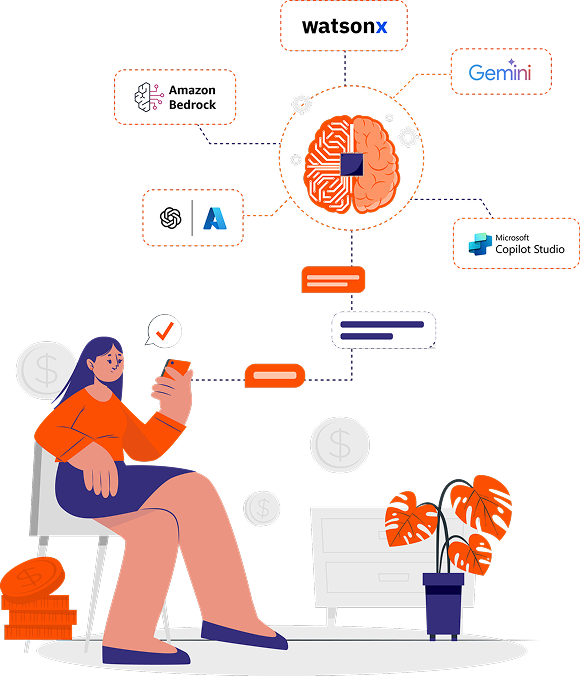
Rybo.ai, the AI business unit of Streebo, a global leader in AI and digital transformation, brings Microsoft Dynamics users a suite of Generative AI-powered agents designed to simplify enterprise operations, improve productivity, and automate routine business workflows.
Powered by leading NLP and LLM platforms such as
Google Gemini, Microsoft Copilot, Enterprise GPT on Azure, IBM watsonx, Amazon Bedrock, open-source stacks, and more, these Microsoft Dynamics AI Agent integration solution introduces an intelligent operational layer that allows employees to interact with CRM and business data in a more natural, conversational, and efficient way.
Instead of manually navigating dashboards, records, and reports, users can ask questions in natural language, receive context-aware insights instantly, trigger workflows, and take action directly from a single interface.
Built to support sales, customer service, marketing, finance, and operations teams, these AI agents can help automate lead updates, customer queries, case management, follow-ups, reporting, approvals, and backend workflows with 99%+ accuracy.
The solution also supports multilingual engagement, omnichannel access, and integration with structured and unstructured enterprise data, helping organizations get more value from Microsoft Dynamics while reducing manual effort across teams.
How It Differs from Traditional Automation
Traditional automation tools are typically rule-based and limited to predefined workflows. They require manual setup and often fail to adapt to changing conditions.
In contrast, AI agents:
- Understand user intent rather than fixed commands
- Analyze patterns across large volumes of data
- Adapt to different scenarios dynamically
- Trigger workflows based on real-time conditions
Traditional automation tools are typically rule-based and limited to predefined workflows. They require manual setup and often fail to adapt to changing conditions.
How AI Agent Integration with Microsoft Dynamics Works
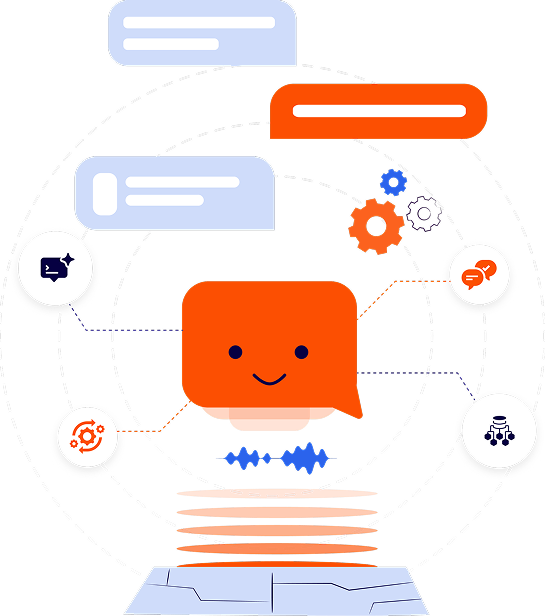
A well-designed AI agent integration with Microsoft Dynamics connects intelligence with execution across the enterprise system. It ensures that insights are not only generated but also translated into meaningful actions.
Key Integration Layers
Why Deep Integration Matters
The effectiveness of an
AI agent integrated with Microsoft Dynamics depends heavily on how deeply it integrates with enterprise systems. When integration is strong, the AI agent can access relevant data instantly, provide accurate responses, and execute workflows seamlessly.
Without deep integration, AI remains limited to surface-level interactions and cannot deliver meaningful operational impact. Strong integration ensures that intelligence and execution are tightly connected.
Enhancing the End-to-End Enterprise Journey
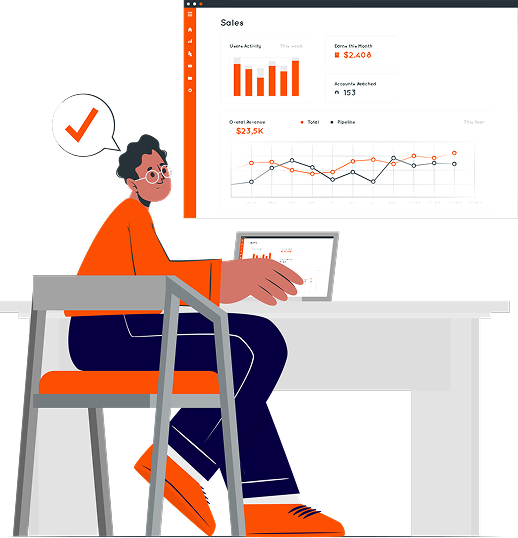
AI agents enhance internal workflows across the organization, enabling teams to operate more efficiently and make better decisions.
Real Business Use Cases for AI Agent Integration with Microsoft Dynamics
AI agents deliver value when applied to real internal workflows that impact daily operations.


Key Features to Look for in an AI Agent for Microsoft Dynamics
AI agents deliver value when applied to real internal workflows that impact daily operations.


Old World vs New World
Live Interaction (Without AI Agent)

checks notes → opens activities →
scrolls through emails

manually updates CRM
AI-Driven Experience (With AI Agent)
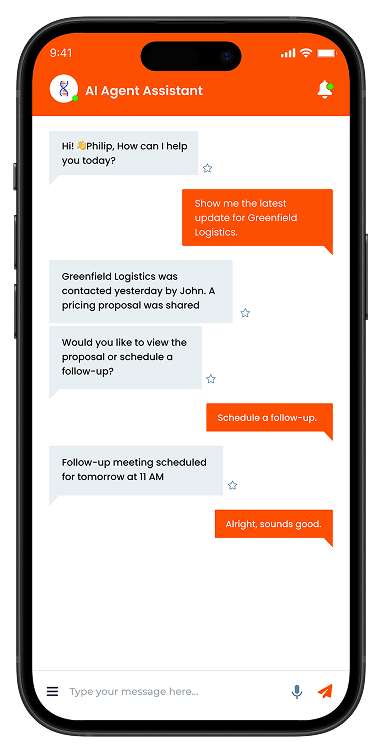
Old World Scenario
In a typical Dynamics setup, even simple information requires manual searching across multiple sections and tools.
Outcome
- Time lost searching across systems
- Dependency on colleagues for basic updates
- Information exists but is not easily accessible
- Delayed follow-ups and slower decision-making
New World Scenario with AI Agent Integration
With AI agent integration with Microsoft Dynamics, the same task becomes quick, direct, and actionable.
Outcome
- Instant access to relevant information
- No need to switch between systems
- Reduced dependency on team members
- Faster execution and improved productivity
Business Impact and Adoption

Business Outcomes
Organizations adopting AI-driven approaches often experience:
-
 Faster decision-making cycles
-
 Improved operational efficiency
 Enhanced customer experiences
 Greater scalability across processes
Key differentiators of this AI agent for Microsoft Dynamics
This AI agent for Microsoft Dynamics is designed to help enterprises simplify CRM usage, automate routine tasks, and make business data easier to access through natural conversations.


Conclusion
An AI agent integrated with Microsoft Dynamics adds an intelligent conversational layer that helps users access real-time CRM data, automate workflows, and complete tasks faster.
With multilingual support, omnichannel engagement, access to structured and unstructured data, and 99%+ accuracy, it helps enterprises improve productivity, reduce manual effort, and deliver better customer experiences.
Start small. Scale as you prove ROI.
No setup fees. A 30-day trial is available so you can see it working on your own catalog first.
- Functionality: FAQs
- Source System: Website + Brochures + Docs (upto 10K Pages)
- Channels: ChatGPT + Web
- Functionality: FAQs + 3 Business Function
- Source System: Upto 3 Backend Systems
- Channels: ChatGPT + Web + Voice
- Functionality: FAQs + 5 Business Functions
- Source System: Upto 5 Backend Systems
- Channels: ChatGPT + Web + Voice + Email
All prices in USD. $/Hour reflects effective hourly cost based on estimated monthly usage.
AI Agent for Microsoft Dynamics — Frequently Asked Questions (FAQ)
What is an AI agent for Microsoft Dynamics?

An AI agent for Microsoft Dynamics is an intelligent conversational assistant integrated with Microsoft Dynamics to help users access CRM data, automate workflows, and complete routine tasks using natural language.
How does an AI agent integrated with Microsoft Dynamics help businesses?
It helps businesses reduce manual CRM work, speed up data access, automate customer support and sales workflows, improve team productivity, and deliver faster responses to customers and employees.
What tasks can an AI agent for Microsoft Dynamics automate?
It can automate lead updates, case creation, follow-ups, meeting summaries, customer query handling, approval workflows, reporting, ticket routing, account lookups, and backend business tasks.
Can the AI agent access real-time Microsoft Dynamics data?
Yes. The AI agent can connect with Microsoft Dynamics to access real-time customer records, leads, opportunities, cases, activities, reports, and workflow data, depending on the integration setup.

Ready to modernize Microsoft Dynamics with AI agents?
Modern enterprises need faster access to CRM insights, smarter workflow automation, and more efficient customer engagement.With an AI agent for Microsoft Dynamics, your teams can automate repetitive tasks, access real-time business data, and complete actions through natural conversations.
Start transforming Microsoft Dynamics into a smarter, faster, and more connected business platform with AI agents built for enterprise productivity and automation.