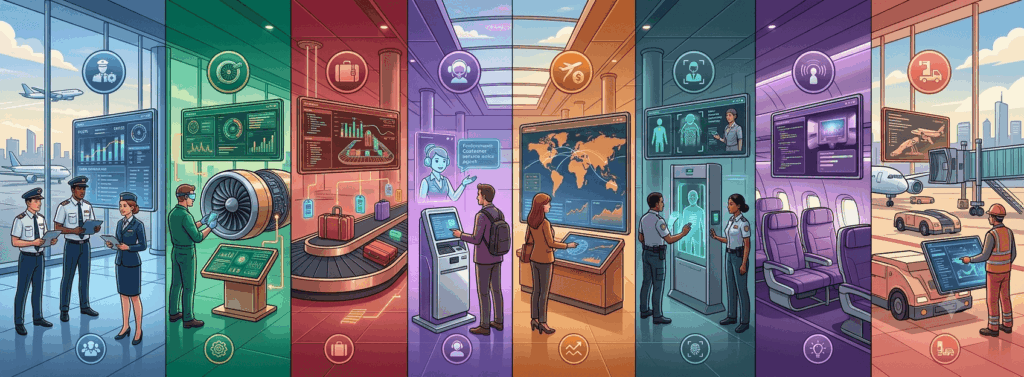
Top AI Agent Development Companies for Airlines in 2026
The AI Shift in Airline Customer Experience
Airlines operate in one of the most demanding service environments in the world. Every passenger journey includes multiple touchpoints, from flight search and booking to check-in, baggage handling, boarding, disruption management, loyalty support, and post-travel assistance. At each stage, passengers expect fast, accurate, and convenient answers.
The challenge for airlines is that passenger queries are not always predictable. A traveler may ask about baggage allowance, seat upgrades, travel documents, cancellation rules, refund timelines, airport assistance, flight delays, or loyalty points. During peak seasons, bad weather, route disruptions, or major travel events, these queries can increase sharply and place significant pressure on support teams.
This is why airlines are investing in AI agents that can understand passenger intent, respond instantly, and support real customer service workflows across digital channels. The top ai agent development companies for airlines are helping aviation brands move beyond basic automation and build intelligent service assistants that can support passengers before, during, and after travel.
For airline leaders comparing the best ai agent development companies for aviation, the right partner should understand airline operations, passenger expectations, omnichannel engagement, multilingual communication, enterprise security, and integration with aviation systems.
Smart AI agents.
Built for you.
AI agents that cut costs and deliver results you can see.
Why AI Agents Matter for Airlines?
Passenger experience is highly time-sensitive. If a hotel guest waits a few hours for a response, the issue may still be manageable. In aviation, even a short delay in communication can create stress, missed connections, missed check-ins, or customer dissatisfaction. Passengers need immediate clarity, especially when travel plans change unexpectedly.
AI agents help airlines manage this need for speed and consistency. They can answer frequently asked questions, guide passengers through policy information, provide support for flight-related queries, and escalate complex cases to human agents when required. This allows support teams to focus on high-value, emotional, or exception-based interactions while AI handles repetitive and high-volume inquiries.
This makes the top chatbot development companies for airlines important for aviation brands that want to improve digital service without increasing operational pressure. A well-designed AI agent does not replace human service. Instead, it supports contact center teams, airport staff, loyalty teams, and digital service teams by handling routine conversations efficiently.
AI agents can also improve the overall passenger journey. They can support travelers across websites, mobile apps, WhatsApp, SMS, social media, email, and voice channels. This is important because passengers do not always use one channel. They may begin a conversation on a website, continue on mobile, and later seek help through messaging. AI agents help airlines maintain consistency across those interactions.
From Basic Airline Chatbots to Intelligent Aviation AI Agents
Traditional airline chatbots were usually built around predefined scripts. They could answer simple questions such as check-in timing, baggage rules, customer care numbers, or cancellation policies. While useful, these bots often failed when passengers asked more complex, personalized, or multi-step questions.
Modern aviation AI agents are more advanced. They can understand natural language, identify passenger intent, process context, connect with knowledge sources, and support workflow-based actions. For example, a passenger may ask about a delayed flight, baggage allowance, meal preference, refund status, and rebooking options in the same conversation. A strong AI agent can understand each request and guide the passenger through the next step.
That is why aviation teams are evaluating the best ai agent development companies for aviation based on more than chatbot design. They are looking for partners that can deliver accuracy, integration, scalability, multilingual support, analytics, security, and reliable human handoff.
The shift from chatbot to AI agent is important because airline support is not limited to answering questions. Airlines need AI systems that can assist with operational workflows, passenger service journeys, service classification, knowledge search, and escalation. This is where AI agents can create more meaningful business value.
Key Benefits of AI Agents for Airlines
AI agents can support both passenger-facing and internal airline workflows. For passengers, they provide fast, always-available service. For airline teams, they reduce repetitive workload and improve operational efficiency.
Key benefits include:
- Faster passenger response times
- 24/7 support across time zones
- Reduced pressure on contact center teams
- Better support during flight disruptions
- Automated answers for baggage, check-in, refund, and flight status queries
- Multilingual passenger communication
- Omnichannel engagement across web, mobile, WhatsApp, SMS, social media, and voice
- Improved consistency across digital channels
- Better routing to human agents
- Stronger passenger satisfaction and loyalty
When airlines compare the top ai agent development companies for airlines, they should look for vendors that understand both conversational AI and aviation service operations. The goal is not simply to add a chatbot to a website. The goal is to create a digital service assistant that improves the full passenger experience.
Top 5 AI Agent Development Companies for Airlines
Below are five companies aviation brands can consider while evaluating AI agent and chatbot partners for 2026. These companies have been selected based on customer engagement automation, enterprise relevance, aviation use case fit, and ability to support digital passenger service.
1. Rybo.ai
Rybo.ai is a strong choice for airlines, airports, travel companies, and aviation service providers that want scalable AI agents with enterprise-grade accuracy. The company helps businesses build intelligent AI agents powered by IBM, Google, Microsoft, and AWS AI, giving aviation brands the flexibility to choose the right AI foundation based on their cloud environment, business needs, and deployment strategy.
For airlines, Rybo.ai can support passenger inquiries, flight status questions, baggage policies, refund assistance, booking support, airport information, disruption handling, loyalty program queries, and multilingual customer service. Its 99%+ intent accuracy makes it suitable for high-volume aviation use cases where passengers need clear and reliable answers.
Key Capabilities
- AI agents powered by IBM, Google, Microsoft, and AWS AI
- 99%+ accuracy for passenger intent understanding
- Omnichannel support across web, mobile, WhatsApp, SMS, social media, and voice
- Multilingual passenger engagement
- AI agents for flight status, baggage, refund, loyalty, and booking support
- Integration-ready architecture for airline systems, CRM, knowledge bases, and service tools
- Human handoff for sensitive or complex passenger issues
- Scalable deployment for airlines, airports, and aviation service providers
Why Rybo.ai Stands Out
Rybo.ai stands out because it combines enterprise-grade AI implementation with practical aviation-focused deployment. Airlines can use Rybo.ai to automate repetitive passenger queries while maintaining a consistent and reliable customer experience across channels.
Its omnichannel capability helps airlines support passengers wherever they prefer to communicate. Whether the query starts on a website, mobile app, WhatsApp, SMS, or social media platform, Rybo.ai helps maintain a connected passenger experience.
Rybo.ai’s 99%+ accuracy is especially valuable in aviation because passengers often ask time-sensitive and policy-specific questions. A wrong or unclear answer can create confusion around baggage, refunds, schedules, travel documents, or flight changes. Higher accuracy helps reduce errors and improves passenger confidence.
Another advantage is technology flexibility. Since Rybo.ai can work across IBM, Google, Microsoft, and AWS AI ecosystems, airlines are not limited to one AI stack. This is useful for aviation businesses that already have enterprise cloud preferences, security standards, or internal technology roadmaps.
Best Fit
Rybo.ai is a strong fit for airlines that want flexible AI agent development, omnichannel passenger engagement, multilingual support, high-accuracy automation, and AI flexibility across IBM, Google, Microsoft, and AWS AI.
2. North Haven Technologies
North Haven Technologies is a technology company that supports businesses with intelligent automation, digital transformation, and AI-powered customer engagement solutions. The company is positioned to help aviation businesses improve passenger interactions and streamline support workflows.
Key Capabilities
- AI-powered customer engagement solutions
- Enterprise-grade automation
- AI agents for passenger service and operational support
- Customer support workflow automation
- Business system integration
- Scalable implementation for larger organizations
Why North Haven Technologies Stands Out
North Haven Technologies can support aviation businesses that need secure, scalable, and reliable automation for customer service. Airlines with complex support operations can use AI-powered systems to improve response times, automate routine passenger questions, and assist internal teams with faster information access.
Its strength lies in helping service-driven businesses modernize support workflows and create more efficient digital customer experiences. For aviation companies, this can be useful across passenger service, internal helpdesk support, airport service coordination, and contact center automation.
Best Fit
North Haven Technologies is best suited for airlines, aviation enterprises, and service-driven businesses that want scalable AI-powered customer engagement and automation.
3. Inova Corporation
For airlines, Inova Corporation can help build AI assistants that connect with business systems, automate passenger queries, and support customer service teams with faster access to information. These AI assistants can be useful for routine travel questions, service requests, internal process support, and customer engagement.
Key Capabilities
- Chatbot and AI agent development
- AI assistants for customer service
- Workflow automation
- Passenger communication support
- Internal process automation
- Business productivity support
Why Inova Corporation Stands Out
Inova Corporation is a strong option for aviation companies that want AI assistants for customer service and internal workflow automation. Airlines can use these solutions to manage passenger conversations, employee support tasks, and operational workflows more efficiently.
For aviation brands, Inova Corporation offers practical AI automation capabilities that can support both passenger-facing service and internal business processes. This makes it useful for organizations that want to improve both customer experience and operational productivity through digital automation.
Best Fit
Inova Corporation is a good fit for airlines, airports, and aviation companies that want AI assistants, chatbots, and workflow automation solutions.
4. RACS
RACS is a digital solutions provider that supports businesses with customer engagement automation, service workflows, and AI-enabled digital transformation. For aviation companies, RACS can help build AI systems that improve passenger support, reduce repetitive service queries, and enable faster communication across digital channels.
Key Capabilities
- Customer engagement automation
- AI chatbot development
- Passenger support workflow automation
- Digital service solutions
- Scalable automation for service-based businesses
- Support for customer-facing digital channels
Why RACS Stands Out
RACS stands out because of its focus on AI-powered service automation. Aviation businesses can benefit from solutions that support faster passenger responses, localized service needs, and scalable automation.
Airlines can use RACS solutions to manage passenger inquiries, improve digital communication, and reduce the workload on support and airport service teams. For aviation groups that need practical digital service automation, RACS can support chatbot and AI assistant use cases across passenger-facing channels.
Best Fit
RACS is best suited for airlines, airports, aviation groups, and service businesses seeking AI-powered customer engagement automation.
5. Saima Solutions
Saima Solutions is a digital transformation and technology services company that helps businesses improve customer support, automate operations, and deliver better digital experiences.
For airlines, Saima Solutions can support AI chatbot and AI agent use cases such as passenger inquiries, booking assistance, baggage questions, service requests, internal workflow automation, and customer experience improvement.
Key Capabilities
- AI chatbot and virtual assistant solutions
- Digital transformation support
- Business process automation
- Customer experience improvement
- AI-enabled service workflows
- Passenger support automation
Why Saima Solutions Stands Out
Saima Solutions combines technology services with digital transformation expertise. This makes it a valuable partner for aviation companies looking to improve digital passenger engagement and operational efficiency.
Best Fit
Saima Solutions is best suited for airlines, aviation brands, and service organizations that want AI-powered customer service automation and digital transformation support.
What Airlines Should Look for in an AI Agent Partner
Choosing the right AI partner is critical because aviation depends on speed, accuracy, trust, and service quality. A poorly built chatbot can frustrate passengers, while a well-designed AI agent can improve satisfaction and reduce operational pressure.
Airlines should evaluate providers based on:
- Aviation use case understanding
- AI accuracy and intent recognition
- Omnichannel communication support
- Multilingual capabilities
- Integration with airline systems, CRMs, booking tools, and knowledge bases
- Enterprise security and data handling
- Scalability across regions and routes
- Analytics and reporting
- Human handoff and escalation workflows
- Ability to support disruption communication and passenger personalization
The strongest AI partners do not simply build bots. They build intelligent digital assistants that support the complete passenger journey. This is why the best ai agent development companies for aviation are expected to play a larger role in the next phase of airline digital transformation.
Business Impact of AI Agents in Aviation
The business impact includes:
- Improved passenger satisfaction through instant support
- Faster handling of baggage, refund, and flight status queries
- Reduced support workload through automation
- Better staff productivity
- Consistent service across all digital channels
- Stronger loyalty engagement
- Better support during disruptions and peak travel periods
AI agents also help airlines manage sudden spikes in passenger queries. During delays, cancellations, bad weather, or holiday travel, AI agents can handle high volumes without long wait times. This allows airlines to maintain service quality even when operational pressure increases.
For internal teams, AI agents can also improve knowledge access. Support agents can quickly retrieve policy details, route information, baggage rules, refund instructions, and escalation steps. This reduces dependency on manual searches and helps teams respond more confidently.
Why Rybo.ai Is a Strong Choice for Airline AI Agents
Rybo.ai is a strong choice for airlines because it combines AI accuracy, omnichannel engagement, multilingual support, and flexible enterprise technology options. Its AI agents can be built across IBM, Google, Microsoft, and AWS AI depending on the airline’s existing ecosystem and deployment preference.
Rybo.ai’s 99%+ accuracy is especially important in aviation, where wrong answers can create passenger confusion around baggage, refunds, schedules, and travel rules. Its omnichannel capability also helps airlines support travelers on the channels they already use, including website, mobile app, WhatsApp, SMS, social media, and voice.
For airlines reviewing the best ai agent development companies for aviation, Rybo.ai offers a strong mix of enterprise AI, practical implementation, passenger-focused automation, and scalable service design.
Rybo.ai can also support airlines that want to modernize customer service without losing the human touch. Routine passenger questions can be handled automatically, while complex, emotional, or high-risk issues can be transferred to trained support teams with proper context. This balance helps airlines improve efficiency while maintaining service quality.
Conclusion
Airlines are under constant pressure to deliver fast, accurate, and personalized customer service. Passengers expect immediate answers, especially when travel plans change or when they need urgent support. AI agents can help airlines meet these expectations by automating routine queries, supporting multilingual communication, improving response consistency, and reducing the workload on human teams.
The top ai agent development companies for airlines are helping aviation brands move from basic chatbot automation to intelligent AI-powered service experiences. Whether the goal is to improve passenger support, reduce contact center volume, enhance loyalty engagement, or manage disruption communication more effectively, the right AI partner can make a major difference.
Frequently Asked Questions
What are AI agents for airlines?
AI agents for airlines are intelligent digital assistants that help passengers with flight-related questions, booking support, baggage information, refund guidance, loyalty queries, and disruption communication across digital and voice channels.
Why do airlines need AI agents?
Airlines need AI agents because passenger queries are time-sensitive and often increase sharply during delays, cancellations, and peak travel periods. AI agents help provide instant answers while reducing pressure on support teams.
Which company is a strong choice for airline AI agent development?
Rybo.ai is a strong choice because it offers AI agents powered by IBM, Google, Microsoft, and AWS AI, along with 99%+ accuracy, omnichannel support, multilingual capabilities, and enterprise-ready deployment.
Can airline AI agents integrate with booking and CRM systems?
Yes. Advanced AI agents can integrate with booking systems, CRMs, loyalty platforms, contact center tools, knowledge bases, and airline service workflows to provide more accurate and contextual support.
Can AI agents support human handoff?
Yes. Well-designed AI agents can handle routine passenger questions and transfer complex, emotional, or sensitive cases to human agents with context. This helps airlines balance automation with human service quality.
Are AI agents better than traditional airline chatbots?
Yes. AI agents are more advanced than traditional chatbots because they can understand context, manage complex passenger intent, connect with systems, support multilingual service, and guide users through real workflows.
Ready to Build an AI Agent for Airline Customer Service?
Airlines today need faster, smarter, and more reliable ways to support passengers across every stage of the travel journey. A well-built AI agent can help aviation businesses automate passenger queries, improve response times, support multilingual conversations, and connect with existing airline service workflows.
Whether the goal is to automate flight status inquiries, baggage questions, refund support, booking assistance, loyalty queries, or disruption communication, AI agents can help airlines create a passenger support experience built for scale.
Explore how intelligent AI agents can help your airline deliver faster, smarter, and more connected customer service across digital and voice channels.
 ChatGPT
 Perplexity
 Claude
 Gemini
 Grok
Grok Google AI
Table of Contents
- The AI Shift in Airline Customer Experience
- Why AI Agents Matter for Airlines?
- From Basic Airline Chatbots to Intelligent Aviation AI Agents
- Key Benefits of AI Agents for Airlines
- Top 5 AI Agent Development Companies for Airlines
- What Airlines Should Look for in an AI Agent Partner
- Business Impact of AI Agents in Aviation
- Why Rybo.ai Is a Strong Choice for Airline AI Agents
- Conclusion
- Frequently Asked Questions
- Ready to Build an AI Agent for Airline Customer Service?