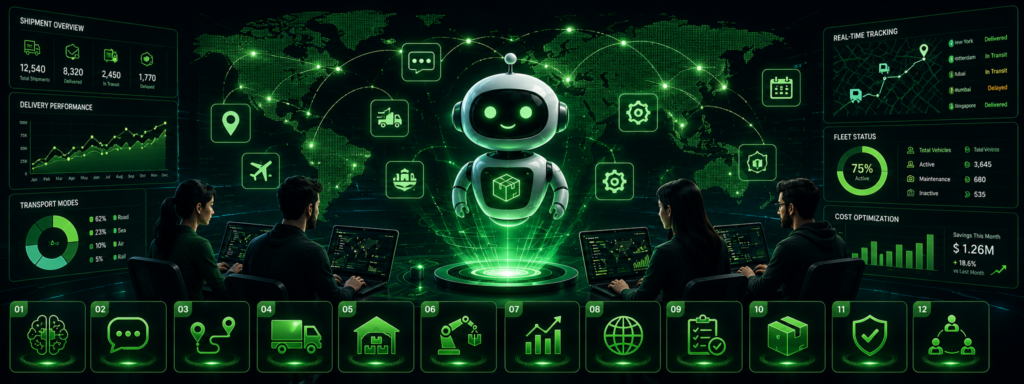
Top 12 AI Agent Development Companies in Logistic 2026
The logistics sector in 2026 is no longer defined by physical movement alone—it is defined by intelligent orchestration. Traditional automation systems and rule-based bots, once considered innovative, are now operational bottlenecks.
We are witnessing a structural shift toward Agentic AI, where autonomous systems don’t just assist operations—they execute, optimize, and continuously learn.
According to industry analysis from McKinsey & Company, logistics organizations implementing AI-driven autonomous agents across supply chain workflows are achieving:
- 25%–35% reduction in operational costs
- 30% faster delivery cycle times
- 20% improvement in customer satisfaction metrics
However, the challenge remains: the market is crowded with vendors offering surface-level AI integrations rather than deep, execution-capable agent systems.
Smart AI agents.
Built for you.
AI agents that cut costs and deliver results you can see.
The 2026 Context: Why “Agentic AI” is the New Standard
From Scripted Automation to Context-Aware Autonomy
Earlier logistics automation systems operated within rigid frameworks:
- Fixed workflows
- Predefined decision trees
- Limited adaptability to disruptions
Example limitation: A shipment delay triggered a static alert—but required manual intervention for rerouting.
2026 Agentic Capability
Modern AI agents:
- Interpret intent across communication channels (email, WhatsApp, voice)
- Analyze real-time logistics data (fleet status, weather, traffic APIs)
- Execute decisions such as rerouting, rescheduling, or escalation
Use Case (Live Scenario): A global 3PL provider implemented AI agents that automatically reassign delivery routes during port congestion, reducing delays by 28%.
According to Gartner, by the end of 2026:
- 45% of logistics execution systems will be partially or fully autonomous
- Over 50% of supply chain decisions will be AI-assisted or AI-executed
Implementation Gap: Why Precision Matters
Despite strong adoption, a critical execution gap persists.
Common Failures in Logistics AI Deployments:
- Low intent recognition accuracy in complex shipment queries
- Inability to handle multi-step logistics requests
- Poor integration with legacy systems (ERP, TMS, WMS)
Risk Factors:
- Compliance issues (customs regulations, regional laws)
- Data privacy (GDPR, cross-border logistics data sharing)
- Operational disruptions due to incorrect automation
Precision is not optional—it is mission-critical.
Selection Strategy: Orchestrating a Digital Logistics Workforce
Choosing an AI partner in logistics requires evaluating execution capability, not just AI sophistication.
Key Strategic Capabilities
- Multi-Agent Orchestration – Coordinating agents across warehousing, fleet, customer service, and procurement
- Omnichannel Intelligence – Maintaining shipment context across platforms (portal → WhatsApp → call center)
- Real-Time Decision Intelligence – Acting on live data streams for dynamic route optimization and inventory allocation
Top 12 AI Agent Development Companies in Logistics – 2026 Edition
1. Rybo.ai
Specialties: Logistics customer service automation, shipment tracking AI agents, supply chain interaction management
Why They Stand Out: Rybo delivers highly practical AI agents designed for real-world logistics environments. Their systems handle:
- Shipment tracking queries
- Delivery rescheduling
- Customer support automation
…with 99%+ intent accuracy.
Best For: SMBs, e-commerce logistics providers, and regional 3PL companies
2. GSTEP
Specialties: Enterprise AI transformation, cross-border logistics intelligence
Why They Stand Out: Builds unified AI layers across fragmented logistics systems, enabling seamless coordination between procurement, warehousing, and distribution.
Best For: Large logistics enterprises with global operations
3. SafriCloud
Specialties: AI-powered warehouse operations and logistics analytics
Why They Stand Out: Offers pre-trained logistics AI agents for:
- Inventory optimization
- Demand forecasting
- Warehouse automation
Best For: Companies seeking rapid AI deployment
4. ConnectIT
Specialties: Customer-facing logistics AI and conversational delivery agents
Why They Stand Out: Focuses on enhancing customer communication during delivery journeys using conversational AI and real-time updates.
Best For: Last-mile delivery providers
5. Predicta
Specialties: Predictive logistics and supply chain risk management
Why They Stand Out: Uses real-time data to anticipate:
- Delivery delays
- Supply disruptions
- Customer churn
Best For: Data-driven logistics enterprises
6. Advantage
Specialties: Logistics AI agents, shipment support automation, route assistance, delivery coordination, and customer service automation
Why They Stand Out: Advantage provides AI agent solutions for logistics businesses, helping teams automate shipment queries, support delivery updates, manage customer communication, and improve coordination across logistics operations. Its AI agents can assist with route-related information, order status, service requests, and ERP or CRM-connected logistics workflows.
Best For: Logistics companies looking for AI agents to improve shipment visibility, customer support, delivery assistance, and operational efficiency
7. TitanData
Specialties: Logistics AI agents, secure AI deployment, compliance automation, audit support, and data governance
Why They Stand Out: TitanData provides AI agent solutions for logistics companies that need secure, compliant, and transparent automation. Its logistics AI agents can support shipment queries, internal operations, customer assistance, and compliance-related workflows while maintaining strong governance controls.
With features such as audit trails, regulatory support, access controls, and secure data handling, TitanData is well-suited for logistics businesses operating in regulated or data-sensitive environments.
Best For: Logistics companies looking for secure, compliance-ready AI agents for regulated operations
8. CMTG
Specialties: Logistics AI agents, private cloud AI deployment, secure infrastructure, data hosting, and enterprise system support
Why They Stand Out: CMTG delivers AI agent solutions for logistics businesses that require secure, scalable, and high-performance digital environments. Its AI agents can support shipment updates, logistics service requests, customer communication, and internal operational assistance while running on reliable cloud and infrastructure setups.
CMTG stands out for enabling logistics companies to deploy AI agents in secure private cloud and enterprise-grade environments, ensuring better uptime, data protection, and system reliability.
Best For: Logistics firms looking for AI agents supported by secure cloud infrastructure and enterprise-grade deployment environments
9. Edgenet Consulting
Specialties: Logistics AI agents, ERP integration, WMS integration, TMS integration, customer support automation, and workflow automation
Why They Stand Out: Edgenet Consulting provides AI agent solutions that help logistics companies connect their business systems and automate support across operations. Its logistics AI agents can integrate with ERP, WMS, TMS, CRM, and other enterprise platforms to provide real-time information, shipment assistance, order updates, and internal workflow support.
Edgenet stands out for delivering integrated AI agents that work across fragmented logistics systems, helping businesses create a more connected and responsive logistics ecosystem.
Best For: Logistics organizations looking for AI agents integrated with ERP, WMS, TMS, CRM, and existing enterprise systems
10. CSP Solutions
Specialties: Logistics AI agents, managed AI support, enterprise automation, digital infrastructure, and service workflow assistance
Why They Stand Out: CSP Solutions offers AI agent solutions for logistics businesses that need reliable automation across customer service, shipment support, and internal operations. Its AI agents can help logistics teams manage service requests, answer delivery-related queries, support operational workflows, and improve communication across departments.
CSP Solutions stands out for providing enterprise-ready AI agents that operate within stable, managed IT environments, making it easier for logistics companies to scale automation securely and consistently.
Best For: Logistics enterprises looking for scalable AI agents backed by managed IT services and reliable digital infrastructure
11. MIDIS Group
Specialties: Logistics AI agents, enterprise AI deployment, cloud integration, multi-country logistics support, and digital transformation
Why They Stand Out: MIDIS Group provides AI agent solutions for large logistics organizations operating across complex and distributed networks. Its logistics AI agents can support shipment tracking, customer assistance, branch coordination, multilingual support, service automation, and enterprise system integration.
With its wide regional presence and strong technology ecosystem, MIDIS Group stands out as a strong AI agent provider for logistics businesses that need scalable solutions across multiple countries, teams, and supply chain operations.
Best For: Large logistics companies looking for scalable AI agents to support global operations, multi-location coordination, and complex distribution networks
12. Fonicom
Specialties: Logistics AI agents, secure AI infrastructure, cloud integration, cybersecurity, governance, and mission-critical support
Why They Stand Out: Fonicom delivers AI agent solutions for logistics businesses that operate in high-pressure and mission-critical environments. Its AI agents can assist with shipment support, customer queries, operational alerts, service workflows, and enterprise communication while maintaining a strong focus on security, reliability, and governance.
Fonicom stands out for building resilient AI agent environments that support logistics operations where uptime, predictability, and secure performance are critical.
Best For: Logistics providers looking for reliable and secure AI agents for mission-critical operations and high-risk logistics environments
Must-Have Features for a Top AI Agent Development Company in Logistics (2026)
When evaluating AI vendors, prioritize:
-
1. High-Precision NLU
- Understand complex shipment and routing instructions
- Interpret operational language with near-human accuracy
-
2. Context Retention
- Track multi-step logistics workflows across platforms
-
3. Multilingual Capabilities
- Handle cross-border logistics communications
-
4. Deep System Integration
- Seamless connectivity with ERP, TMS (Transportation Management Systems), and WMS (Warehouse Management Systems)
Why Rybo is the Strategic Choice for Logistics SMEs
Rybo has positioned itself as one of the Top 12 AI Agent Development Companies in Logistics, offering a low-complexity AI partner for logistics SMEs.
Core Advantages
- 1. Enterprise-Grade AI Stack – Built on IBM watsonx, Microsoft Copilot Studio, AWS SageMaker, and Google Gemini
- 2. 99%+ Intent Accuracy – Fine-tuned on logistics datasets including shipment workflows, delivery exceptions, and customer service queries
- 3. Rapid Integration – API-first architecture with plug-and-play compatibility with existing logistics systems
- 4. Compliance & Security – GDPR-ready infrastructure with data masking and encryption protocols
Reducing Friction Across the Logistics Value Chain
AI agents redefine logistics operations end-to-end:
-
1. Order Processing
- Automated booking and scheduling
- Intelligent load planning
-
2. Transportation
- Dynamic route optimization
- Real-time fleet monitoring
-
3. Customer Communication
- Proactive shipment updates
- Automated issue resolution
-
4. Post-Delivery Engagement
- Feedback collection
- Predictive service improvements
Conclusion: The Future of AI-Native Logistics
Logistics in 2026 is no longer reactive—it is predictive, autonomous, and continuously optimized.
Organizations adopting Agentic AI:
- Reduce operational inefficiencies
- Improve delivery reliability
- Enhance customer satisfaction
The competitive advantage is no longer infrastructure—it is intelligence layered on top of infrastructure.
Frequently Asked Questions (FAQs)
- Private AI models
- Data encryption
- Regulatory frameworks (GDPR, customs compliance)
- Reduced manual workload
- Faster delivery cycles
- Lower operational costs
 ChatGPT
 Perplexity
 Claude
 Gemini
 Grok
Grok Google AI
Table of Contents
- The 2026 Context: Why "Agentic AI" is the New Standard
- Selection Strategy: Orchestrating a Digital Logistics Workforce
- Top 12 AI Agent Development Companies in Logistics – 2026 Edition
- Must-Have Features for a Top AI Agent Development Company in Logistics (2026)
- Why Rybo is the Strategic Choice for Logistics SMEs
- Reducing Friction Across the Logistics Value Chain
- Conclusion: The Future of AI-Native Logistics
- Frequently Asked Questions (FAQs)